About Insomnia
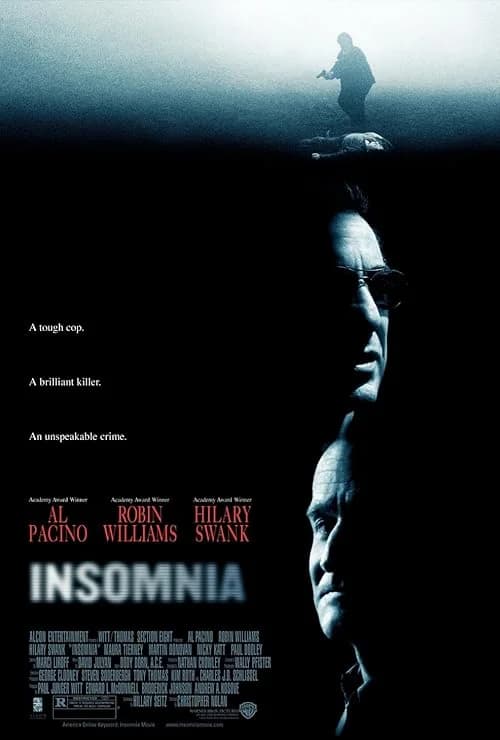
Insomnia (2002) is a gripping psychological thriller that masterfully explores themes of guilt, morality, and the fragility of the human mind under pressure. Directed by Christopher Nolan, this American remake of the 1997 Norwegian film follows veteran LAPD detective Will Dormer (Al Pacino) as he travels to a small Alaskan town to investigate the murder of a teenage girl. The investigation takes a dark turn when Dormer accidentally kills his partner during a fog-shrouded pursuit of the prime suspect, local crime novelist Walter Finch (Robin Williams).
What makes Insomnia particularly compelling is its unique setting—the perpetual daylight of an Alaskan summer—which becomes a powerful metaphor for Dormer's deteriorating mental state. As he struggles with sleep deprivation and growing guilt over his partner's death, Dormer finds himself manipulated by Finch, who witnessed the accidental shooting. The film becomes a tense cat-and-mouse game where the lines between hunter and hunted blur dramatically.
Al Pacino delivers a nuanced performance as the morally compromised detective, perfectly capturing the exhaustion and paranoia of insomnia. Robin Williams, in a rare dramatic role, is chillingly effective as the cunning antagonist. Hilary Swank provides excellent support as a young, idealistic local detective who begins to question Dormer's methods. Nolan's direction is typically precise, creating palpable tension through the stark Alaskan landscapes and clever use of the midnight sun as both setting and psychological device.
Viewers should watch Insomnia for its intelligent exploration of moral ambiguity, standout performances from its legendary cast, and Nolan's signature atmospheric storytelling. The film stands as one of the most underrated entries in Nolan's filmography—a taut, thought-provoking thriller that will keep you engaged from start to finish.
What makes Insomnia particularly compelling is its unique setting—the perpetual daylight of an Alaskan summer—which becomes a powerful metaphor for Dormer's deteriorating mental state. As he struggles with sleep deprivation and growing guilt over his partner's death, Dormer finds himself manipulated by Finch, who witnessed the accidental shooting. The film becomes a tense cat-and-mouse game where the lines between hunter and hunted blur dramatically.
Al Pacino delivers a nuanced performance as the morally compromised detective, perfectly capturing the exhaustion and paranoia of insomnia. Robin Williams, in a rare dramatic role, is chillingly effective as the cunning antagonist. Hilary Swank provides excellent support as a young, idealistic local detective who begins to question Dormer's methods. Nolan's direction is typically precise, creating palpable tension through the stark Alaskan landscapes and clever use of the midnight sun as both setting and psychological device.
Viewers should watch Insomnia for its intelligent exploration of moral ambiguity, standout performances from its legendary cast, and Nolan's signature atmospheric storytelling. The film stands as one of the most underrated entries in Nolan's filmography—a taut, thought-provoking thriller that will keep you engaged from start to finish.